
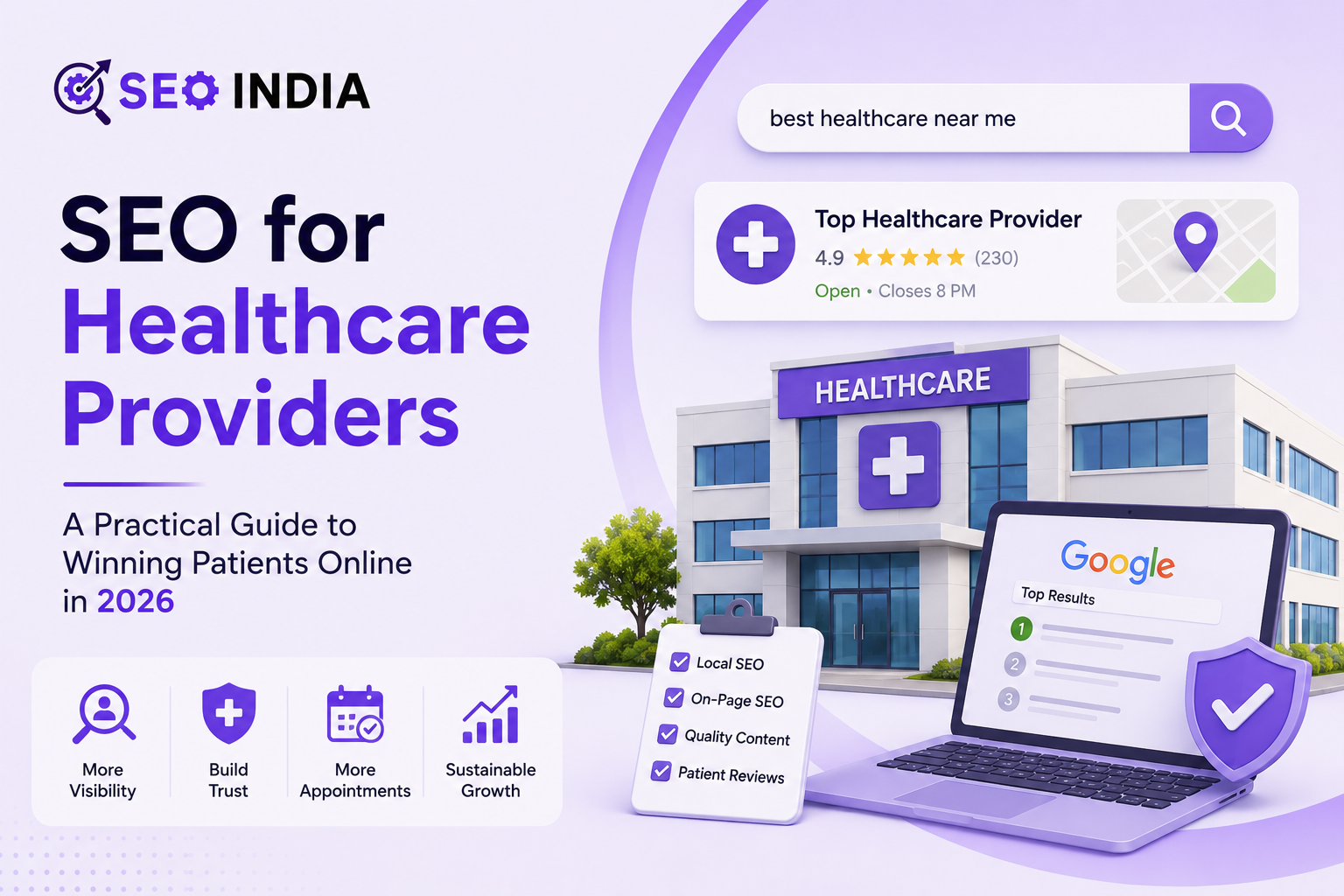
SEO for Healthcare Providers: A Practical Guide to Winning Patients Online in 2026
Key Takeaways Think back to when last you needed to visit a new healthcare provider. You probably didn’t go to a directory or ask a friend. Instead, you typed “best gynaecologist near me” or “who...

Key Takeaways
- SEO in healthcare is no longer optional: The majority of patients search for doctors, clinics, and hospitals on Google. If you’re not on Google, you’re not there.
- Google considers medical content to be “Your Money or Your Life” (YMYL) content Trust signals are extremely important, and include things like having credentials, accuracy, and real patient reviews.
- Your Google Business Profile is usually the fastest way to get new patient calls and bookings. Treat your profile like a living asset and not a one-time setup.
- Showcase individual procedures with clear pricing and include before and after photos. This approach is much more effective than having a generic “services” page.
- Your website should be fast, secure, and mobile friendly. Everything that you may want to build on top will be ineffective if the technical base of your website is broken.
- Patient reviews influence both your Google ranking and the likelihood that a patient will contact you.
- Patient SEO is a long game. You may see some early victories in your local area, but it may take months to see real results from an organic standpoint.
- SEO India is a great choice for specialist help. They offer services that convert users to appointments while remaining compliant with medical marketing laws.
Think back to when last you needed to visit a new healthcare provider. You probably didn’t go to a directory or ask a friend. Instead, you typed “best gynaecologist near me” or “who does wisdom tooth removal in Bangalore” into Google. You probably didn’t go past the results on the first page. It’s safe to say that the majority of your healthcare decisions are made in a search engine.
It’s easy to see why hospital, clinic, and independent practitioner’s SEO for healthcare providers marketing has moved from the “good to have” to the “must have” phase. Your search results are more likely to determine the fate of your appointment than the skill of a doctor. This is even more true for dental practices. Because of the large number of clinics, the constant demand, and the local competitive nature of SEO, the trust and pricing transparency dental care practices have a huge influence on the SEO results.
At SEO India, we have worked with one doctor clinics and hospital chains with many branches. What we have seen time and time again is great care and no digital presence. This is why we have created this guide. We want to show you the value and impact of healthcare SEO, the reason it differs from the SEO of other industries, and how you can become visible to those who are searching for you.
What Makes SEO for Healthcare Different
Google places medical sites in the “Your Money or Your Life” (YMYL) section. This is because poor content in this section could actually harm a person either financially or physically. This placement means medical websites will be held to a higher standard by Google than usual businesses like a clothing shop or a bakery. When evaluating websites, Google focuses on E-E-A-T: Experience, Expertise, Authoritativeness, and Trustworthiness.
This creates a few “must haves” for your practice website:
- Practically, the content has to be clinically accurate and ideally authored by a clinician.
- Practicing clinicians have to display their credentials and specializations.
- The website has to be built well with good security, fast loading, and responsive design.
- Valuable third party endorsements and reviews are more important than in most other industries.
Clinics often ask us why their webpage doesn’t rank well despite the fact that it appears clinically fine.
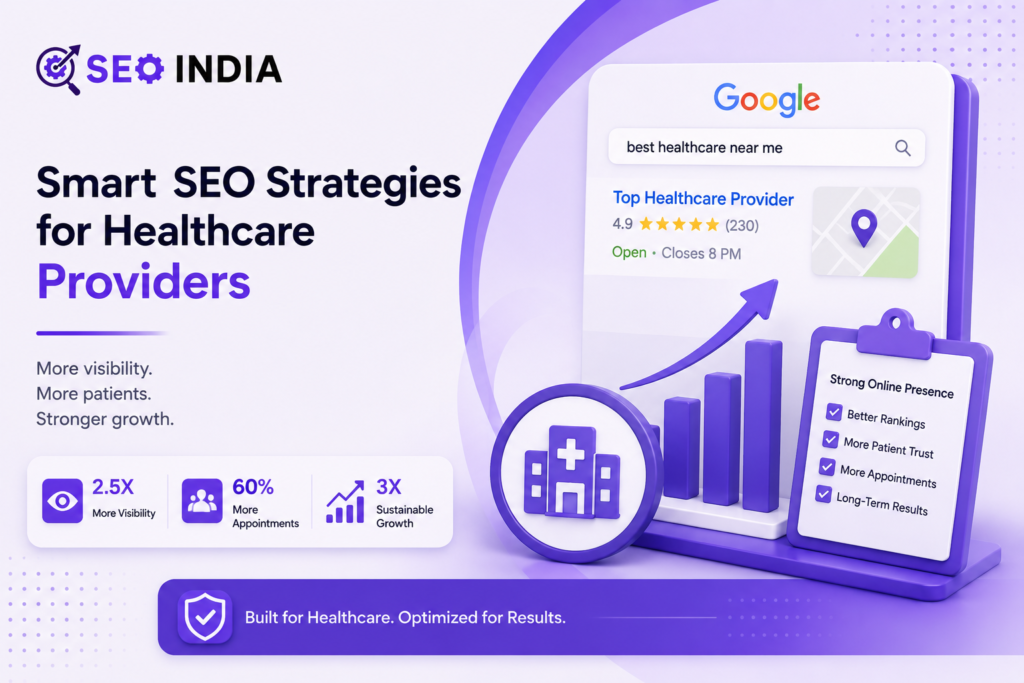
The Building Blocks of Healthcare SEO
1. Local SEO and Your Google Business Profile
The majority of healthcare focused searches are highly localized. For example, searching just “dermatologist” does not mean a dermatologist in another state. This focused local searching also is the main reason that local SEO is the most effective type of SEO for clinics, hospitals, and dental practices.
Your Google Business Profile should not be the type of thing you do once and forget. Instead, you should be viewing:
- Same name, address, and number (NAP) in all other online listings
- Correctly chosen categories (i.e. “Dental Clinic”, “Orthopedic Surgeon”, “Multi-Specialty Hospital”, etc.)
- Regular uploads of new photographs of your Facility, your Equipment, and your Staff
- Continuous new patient reviews with responses to all given by you
- Current business hours, Service offerings, and direct Booking links
Profiles that are maintained are what typically makes the difference in being chosen for the “local pack”; that being the Google map and three listing block shown in the search results for local inquiries.
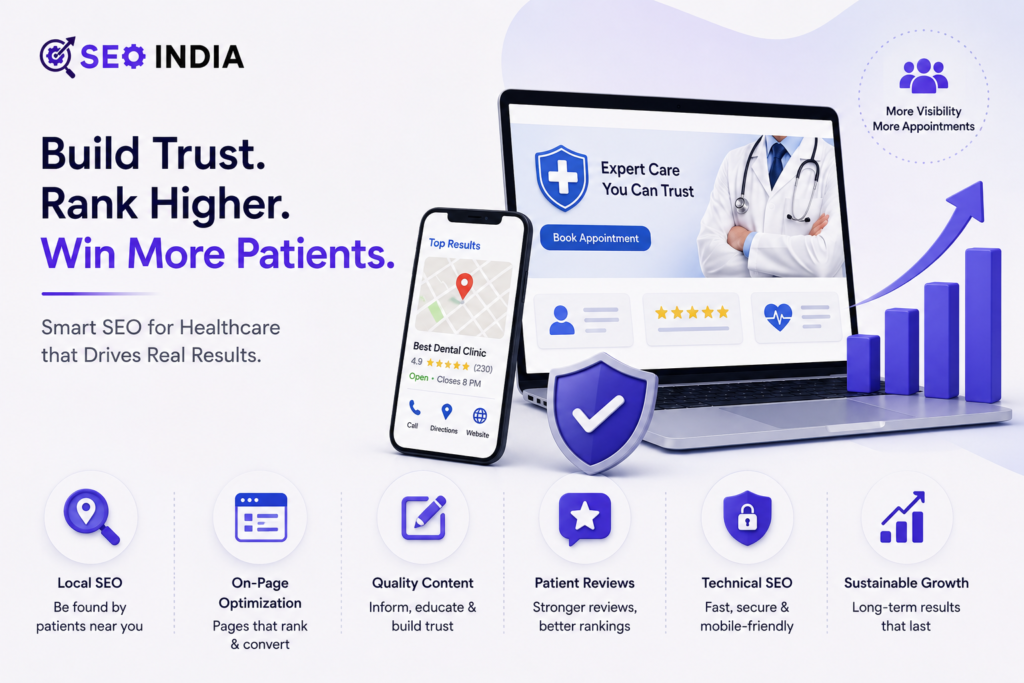
2. On-Page Optimization for Medical Websites
Every page on your site should be dedicated to one thing that a patient may be looking for. Do not try to make your page the all-in-one solution. For dental clinics, that includes having different pages for root canal procedures, whitening procedures, and for pediatric dental services as well as each page having procedures for staff and services.
Few on-page essentials:
- Location-specific title tags and meta descriptions (e.g. “Pune Dental Implants | Free Consultation”).
- H1s, H2s, and H3s that are logical for both the reader and search engine.
- Individual landing pages for all services instead of a single “our services” page.
- Links to associated treatments, blog posts, and doctor profiles.
- Incorporation of medical practice, physician, FAQ and review schema to make your listing rich and stand out in a search.
3. Content That Actually Builds Trust
Patients don’t book appointments without research. You can have content that will be the first to meet the patient in their research. Blog posts, articles, treatment breakdowns, and FAQs will all help you gain the trust of the patient and show your expertise to Google.
Content that works best for dental practices:
- How much do dental implants cost in (your city)?”
- 5 warning signs you might need a root canal”
- Invisalign vs. Metal Braces: Which Suits Your Lifestyle?”
- What happens during a first time dental visit?”
The objective of an SEO strategy is not to obtain a coveted ranking that gives you bragging rights, but to give a patient the answer to a question that they need to know the most at that moment.
4. Technical Health of Your Website
For medical websites, strong content is undermined if your website is slow. Medical websites need to have:
- Speedy Load Time: Website needs to load quickly for patients and Google.
- Mobile-First Design: Most local health searches are conducted on phones.
- Crawl-able website architecture
- Contact and Booking Forms secured via HTTPS and easy to use
- Surveyed Data Markup for your Organization, Doctors, and Services
5. Reviews and Online Reputation
Reviews might be the most underrated part of healthcare SEO. Reviews affect rankings and convert leads. A dental practice with 250+ reviews and a 4.7 star rating will most likely outrank a competitor with 10 reviews, even if that competitor outranks the dental practice in web design.
Have a simple mindset. Ask for reviews from patients that you think will be happy. Again, have the simple mindset and personally respond to reviews whether you find the review to be favorable or unfavorable. Do not engage in “review stuffing” either because this will be seen by Google and will kill your page ranking.
Why SEO for Dental Practices Needs a Dedicated Approach
SEO for Dental Practices needs a dedicated approach because Dental SEO is a distinctly competitive area. You will find a number of dental practices in proximity to each other. Patients will generally engage the practice with the best proximity, highest rating, and perceived best pricing. Each of these areas of concern can be improved by SEO.
For best results, consider the following:
- Pages for each Service and Procedure Provided: Dental Websites should include separate pages for Dental Implants, Orthodontic work, Teeth Whitening, Root Canals, and Cosmetic Dental Services.
- Here’s how the SEO India team can help your website rank higher with the best methods for dental and healthcare focused SEO.
- Browsing Before and After galleries can be especially engaging for potential cosmetic and orthodontic patients.
- SEO Indexed Price Pages. Price search pages convert because a patient is way more likely to look up price before they will look up your phone number.
- Target the most popular inquiries for your emergency services like “open emergency dentist.”
- Implement very short video walk throughs for your clinic/office or an introduction to the doctor. These videos build a great starting level trust and work perfectly on your home page and on your Google Business Profile.
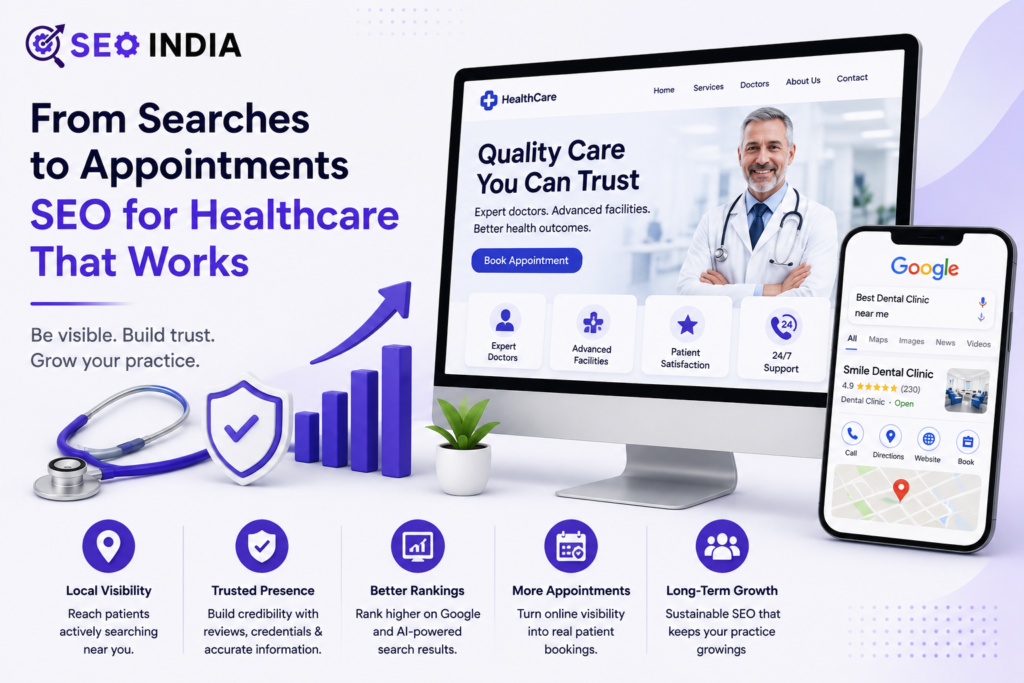
How SEO India Handles Healthcare and Dental SEO
Our team has combined our knowledge of the medical field and our understanding of the local and national markets to build a strategy that actually delivers results, with the main objective of attracting booked appointments, calls, and inquiries.
The first step in our process is a full break down and assessment of your current website and associated tools, followed by a deep analysis of your local and/or regional competitors. The next step is optimizing your Google Business Profile, developing a marketing plan and strategy that is aligned with the most searched queries for your patients, and implementing thorough and ongoing reputation management. Given that healthcare services exist within Google’s YMYL category, we ensure that all the information on your site is structured in a way that reflects both Google’s trust and expertise standards. This ensures that your site can withstand Google’s frequent algorithm updates.
Mistakes That Quietly Sabotage Healthcare SEO
Even well-intentioned companies can fall victim to:
- Thinking Google Business Profile management is a one-time task
- Consolidating multiple services on one page
- Not accounting for the mobile user experience
- Inconsistent NAP across directories
- No review process and reputation is left to chance
- Multiple locations with the same website content
Desktop search is declining and mobile search is king. Phone calls to practices often occur on mobile too. Because of this, the websites of practices must offer a great mobile user experience.
How Long Before You See the Results?
We get asked this every time and we’re honest. The first visible Local SEO changes will have occurred 4 to 8 weeks after the largest change, which is having a Google Business Profile verified. The first meaningful changes for Google as a whole and Healthcare SEO will be observed 4 to 6 months after the first changes. SEO for Healthcare is a never-ending process, just like Healthcare.
Conclusion
Effective healthcare provider SEO is about being found when required. The need may come from a parent searching for a last-minute pediatrician at an inconvenient hour. It can come from a patient in pain searching for the nearest available dentist. It may come from a patient prep for surgery by evaluating the available hospitals for his/her procedure. No matter how big your operation is, whether a regional hospital system or a solo practice, the solutions are the same. Establish trust with your audience through genuine content. Win local SEO with an optimized Google Business Profile, keep your site optimized for speed and mobile usage, and let your online reputation do the heavy lifting.
With a focus on dental practice SEO, the strategies are focused on consistent momentum as there is more value long term than the quick wins. The practices loyal to the effort are the ones found in local searches. If the concern is more on patient care than practice management, leave the tasks to SEO India. We take care of the rest with the technical side of SEO and content and online reputation management with the one goal – more patient bookings.
Frequently Asked Questions (FAQs)
Q1. What does healthcare practice SEO involve?
It means optimizing all the online assets for a practice or hospital. This includes the website, local listings, reviews, and content to rank for the search queries that require your services.
Q2. In what main ways does dental SEO deviate from general healthcare SEO?
Compared to general healthcare SEO, dental SEO is actually less competitive. Dental patients often search for same-day appointments and specific procedures, which can lead to price sensitivity. Hence, dental SEO should have more paged dedicated to specific procedures, with prices and more content regarding local presence.
Q3. What makes the Google Business Profile so important for medical practices?
Most health-related searches include a local component, whether that be a search for “businesses near me” or a search including a city name. Therefore, the Google Business Profile, if optimized properly, lets practices be included in the local map pack, which has a lot of searches and generates many calls.
Q4. Do I have to hire a healthcare SEO agency, or can I work on healthcare SEO in-house?
There are aspects of healthcare SEO you can do in-house, like verifying your Google Business Profile and asking for reviews. You need to consider the content and the healthcare segment. Most practices prefer to partner with a healthcare SEO agency like SEO India for better consistency and performance.
Q5. How much does healthcare SEO cost in India?
It depends on the size of the practice, how many locations you have, how competitive your city is, and your specialty. Most agencies offer a monthly retainer based on how much local SEO they do for you, how much work is required, and how much specific healthcare content is developed.
Q6. Do reviews actually help with SEO?
Absolutely. Having more and recent positive reviews helps practices rank better in local searches and have a higher click-through-rate, since patients have a greater tendency to book with these highly-reviewed practices.
Q7. What’s the turnaround time for dental or healthcare SEO results?
Local SEO results can show up in as little as 4 to 8 weeks. For organic rankings in most other areas, expect around 4 to 6 months for SEO work to gain considerable traction. This will continue to improve as the authority of your site continues to increase.





No Comment! Be the first one.