
Even a Sandwich Shop Is Now an “AI Company”: The Truth Behind AI Hype in IPO Filings
A Blogchowk Analysis Introduction 2026 has turned into one of the strangest years for the stock market. Every company planning an IPO seems to sprinkle the word “AI” somewhere in its...

A Blogchowk Analysis
Introduction
2026 has turned into one of the strangest years for the stock market. Every company planning an IPO seems to sprinkle the word “AI” somewhere in its investor pitch — whether it’s actually building software or just selling submarine sandwiches. This is the story of how the AI hype has quietly spread into industries that have nothing to do with artificial intelligence, and what it really means for investors, founders, and everyday readers trying to make sense of the noise.
At Blogchowk, we track these shifts in the tech and business world so you don’t have to dig through hundreds of pages of legal filings yourself.
What’s the Story
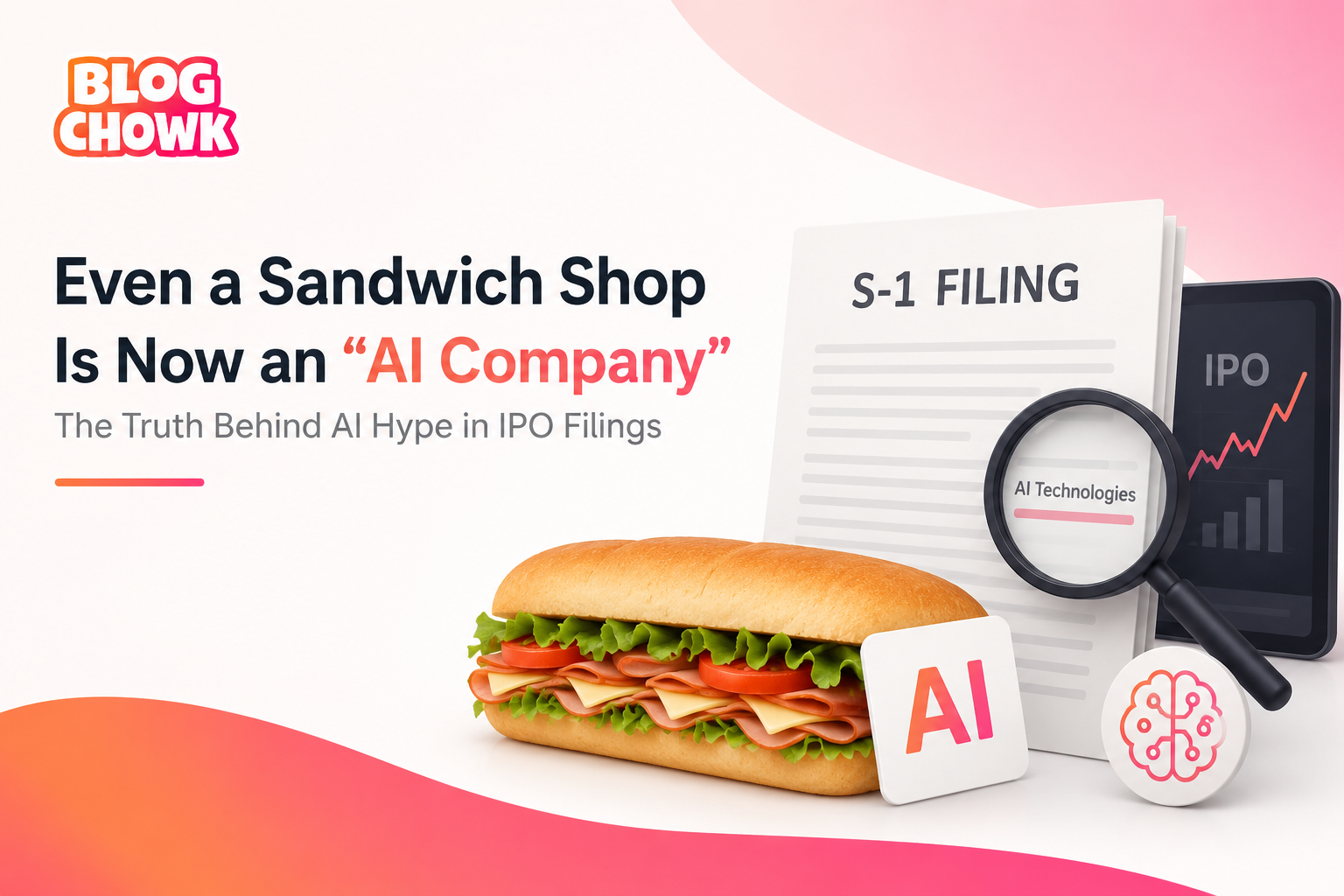
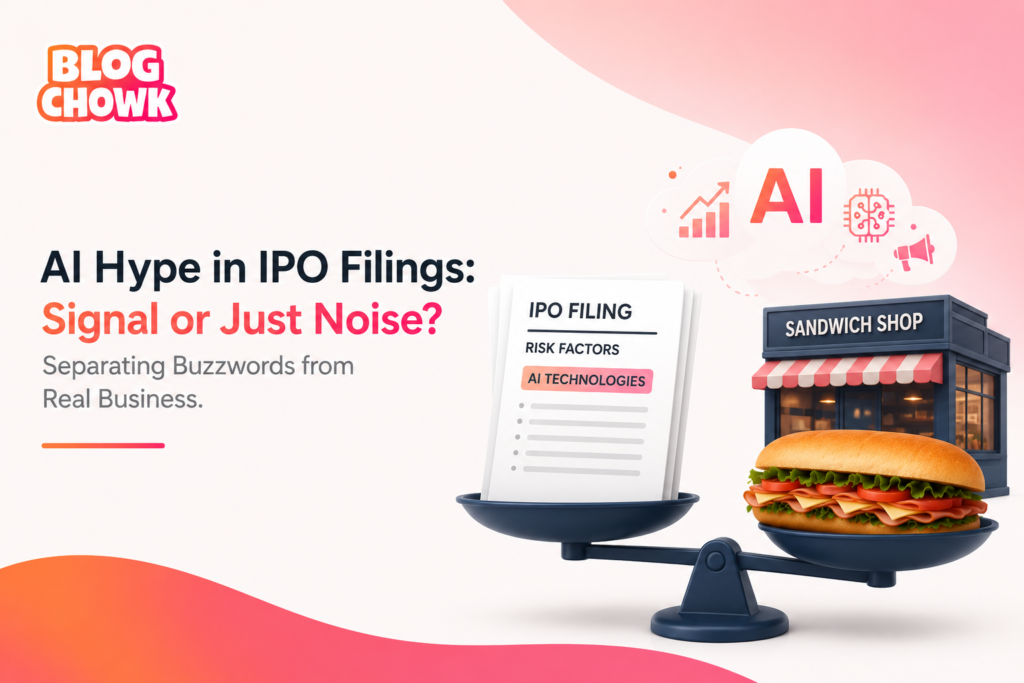
A popular American sandwich chain recently filed for its IPO. Now think about it — a company whose core business is assembling bread, cheese, and meat correctly, mentioned “artificial intelligence” or “AI” 22 times in its S-1 filing with the SEC. This company doesn’t sell an AI product, nor does it claim any AI-powered service anywhere in its operations. Yet, in its investor-risk section, it added a generic, almost throwaway line: “We are beginning to use AI Technologies in our business.”
What’s even more telling is that the company mentioned its actual, tangible operational risks — like weather, supply disruptions, or natural disasters — only a handful of times, while a vague and abstract risk like AI was repeatedly highlighted. This shows how companies are attaching the “AI” label to manage investor sentiment, even when their real, everyday business has little to do with the technology itself.
Why Companies Are Doing This
The reason isn’t complicated. Investor demand for anything AI-related has skyrocketed. Venture capitalists and public market investors alike are chasing companies that can position themselves as part of the AI wave, even loosely. This creates pressure on founders and CFOs to insert AI language into pitch decks and IPO documents, regardless of whether it reflects the actual business model.
This isn’t limited to one company. From early-stage startups raising funding to massive public listings, the same pattern keeps repeating:
- Startups tie an AI angle into their pitch decks, even when their core product is traditional software or an unrelated service.
- Established, decades-old companies add AI risk-warnings to their IPO filings just to appear “future-ready” to Wall Street.
- Investors themselves have become part of the hype cycle — showing disproportionate interest in companies whose paperwork includes the word “AI,” regardless of how central it actually is to the business. [Add your Blogchowk startup-funding article link here]
The Bigger Pattern: AI-Washing
This phenomenon has a name in business and regulatory circles: AI-washing . It’s similar to “greenwashing,” where companies exaggerate their environmental credentials for marketing purposes. The U.S. Securities and Exchange Commission (SEC) itself coined this term and has already taken enforcement action against firms for making false or misleading claims about their AI use.
AI-washing isn’t always illegal — most of the time it’s just optimistic language or generic legal boilerplate added by lawyers to cover future possibilities. But when claims cross into being materially false or misleading, regulators are watching closely, and it does create a confusing environment where genuine AI innovation gets lost in a sea of buzzword-heavy filings.
What Exactly Is an S-1 Filing
For readers who aren’t familiar with the term: an S-1 filing is the official registration document a company files with the SEC before it can go public. It’s meant to give investors a transparent look at the business, its finances, and its risks.
What This Means for Investors
When AI mentions become so common that every industry — food, retail, logistics, healthcare, even sandwich shops — starts force-fitting the term into their documents, it becomes important to separate real signal from noise. Here are three things worth keeping in mind:
- Not every AI mention is meaningful. Often it’s just legal boilerplate or investor-pleasing language added as a precaution, not a genuine business strategy.
- It’s important to distinguish real AI adoption from AI-washing. Whether a company is actually using AI in a way that impacts revenue, cost, or risk — or just inserting the buzzword for optics — is something investors need to verify independently.
- Hype cycles always eventually correct. When the market becomes so saturated that everything appears “AI-powered,” it becomes genuinely harder to spot real innovation from marketing spin.
Blogchowk’s Take
AI is, without question, a transformative and powerful technology. But when a sandwich company mentions AI in its IPO paperwork more often than it mentions the software that actually runs its stores, it’s a clear signal that we’ve reached an advanced — arguably excessive — stage of the hype cycle. Both investors and everyday readers need to learn how to separate substance from marketing spin.
As more companies head toward public listings in the coming months, it will be worth watching closely whether AI mentions genuinely reflect their business models, or whether they’ve simply become a fashionable checkbox that legal teams add out of habit.
Stay tuned to Blogchowk for more breakdowns like this one, where we simplify complex business and tech trends into content you can actually use.
Frequently Asked Questions (FAQ)
1. What does “AI hype” mean in the context of IPOs?
AI hype refers to companies exaggerating or overemphasizing their use of artificial intelligence in official documents like IPO filings, even when AI isn’t central to their actual business, mainly to attract investor interest.
2. What is an S-1 filing?
An S-1 filing is a registration document that companies file with the U.S. Securities and Exchange Commission (SEC) before going public. It discloses business details, financials, and risk factors to potential investors.
3. Is it illegal for companies to mention AI without using it significantly?
Not automatically. Most such mentions are broad, cautionary language added by legal teams to cover future risks, not false claims. However, if a company makes materially false or misleading AI claims to investors, the SEC can and has taken enforcement action.
4. What is “AI-washing”?
AI-washing is when a company exaggerates or overstates its use of artificial intelligence for marketing or investor appeal, similar to how “greenwashing” refers to exaggerated environmental claims.
5. How can investors tell real AI companies from AI-washed ones?
Investors should look at how AI is actually integrated into revenue generation, product features, or operational efficiency — rather than just counting how many times “AI” appears in a filing or pitch deck.
6. Why does this trend matter for everyday readers, not just investors?
Because AI hype affects stock valuations, market trends, and even hiring decisions across industries. Understanding it helps readers make more informed decisions, whether they’re investing, job hunting, or simply following tech news.
7. Where can I read more such breakdowns?
You can follow Blogchowk for regular, easy-to-understand analysis of business, tech, and AI trends shaping today’s market.


No Comment! Be the first one.