
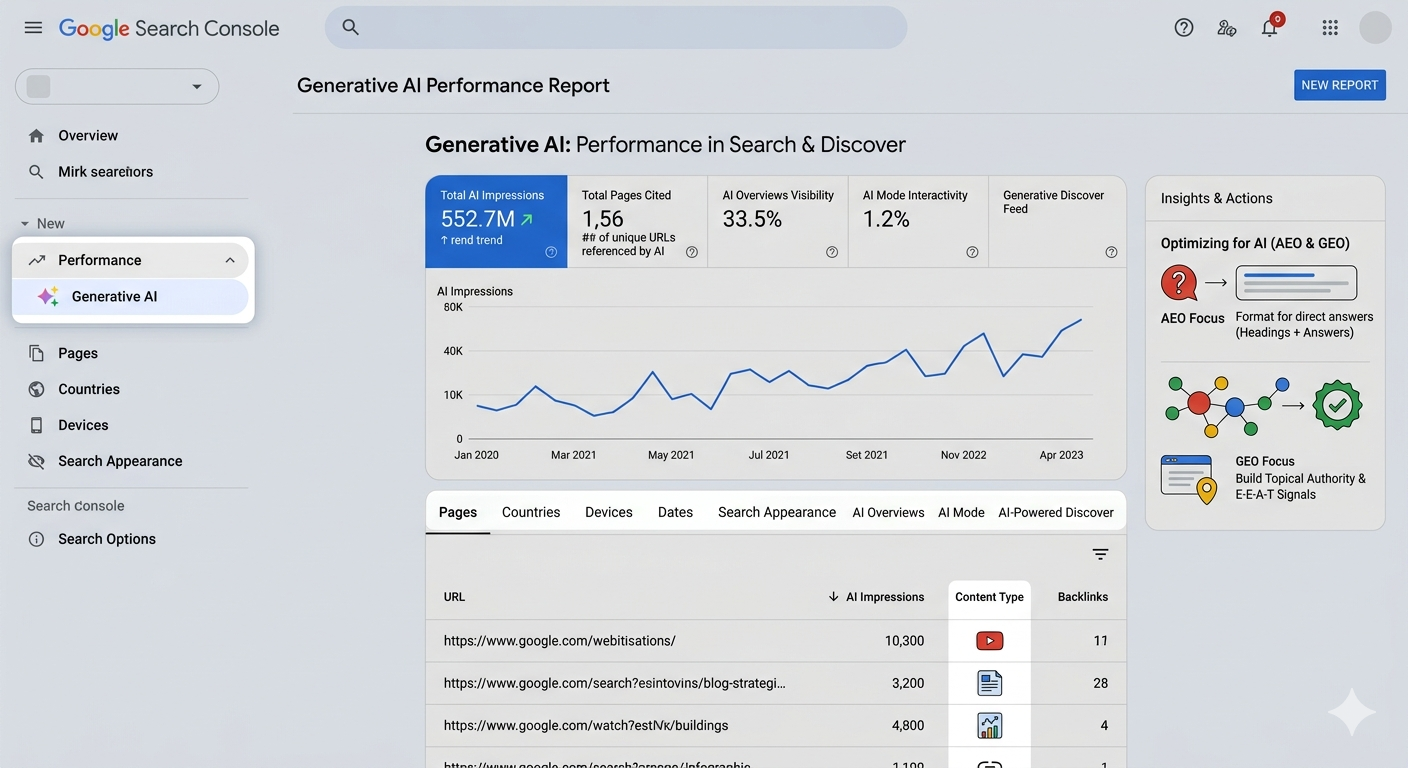
Google has released a monumental update that is rattling the entire search engine optimisation (SEO) industry: Search Generative Artificial Intelligence (AI) Performance Reports have been made available in the Search Console. If you are one of many trying to understand how artificial intelligence will impact search, this release is an enormous milestone based on the aforementioned changes that now allow you to see how your content performs in Google’s AI-driven environments. The metrics derived from these reports are listed below:
• AI Overview
• AI Mode
• AI-Powered Discover Feed
To be honest, we have struggled with tracking visibility within Google’s AI snapshots. We have used everything from third party scraping tools that charge hundreds per month, we have had to check daily manually, and we relied on guess work when trying to obtain this data. This change now provides us with direct, confirmed data from Google.
Conversational search is quickly changing the way that standard internet users search for information and this launch will provide marketers with a definitive playbook on how to navigate Search Engine Optimisation (SEO), Answer Engine Optimisation (AEO), and Generative Engine Optimisation (GEO). Below at Blogchowk we will not only provide an overview of how each of these performance reports track, what is yet to be added, but also how you can start developing your search strategies based on the new dashboard.
What Will Google Provide Us?
Google has announced the completion of the rollout of Search Generative Artificial Intelligence Performance Reports to your traditional Search Console sidebar. The new Google modules were specifically created to isolate your metric information and provide you with the number of times your URLs populate through the various AI features that are created by Google.
The Catch: Don’t panic if you don’t see it in your account just yet. You can read the official announcement on the Google Search Central Blog where they explicitly stated they are rolling this out to a small test group of websites first to gather initial feedback before launching it worldwide. If your dashboard hasn’t updated, your site is simply waiting in the queue for the next rollout wave.
What kind of data is Google going to be providing?
Google will separate these metrics from your standard organic click metric data, so your historical benchmarks remain intact. Once you receive access to the new metrics you will be able to filter the data based on five core areas:
1. Impressions
Impressions are simply how many times a user has seen your link presented within an AI generated interface, recorded through three specific areas:
- AI Overviews: These are the synthesized answer blocks that appear at the top of the standard results page.
- AI Mode: This is the multi-turn interactive chat interface that allows users to ask follow up questions.
- Generative Discover Experiences: These are the conversational and personalized summaries of content that can be found in the feed of a user’s mobile device.
2. Pages
Once again, this is where things become very helpful for developing content strategies. This is where you can see the exact URLs that Google’s algorithm will reference to support the answers it provides. You can look at this list and determine both of the following:_
- Which content type format (i.e., video, blog, infographic, etc.) is easiest for AI to understand and process.
- Which pages you have that are currently receiving high-quality backlinks.Below is a rewritten version of this paragraph:
3. Countries
To identify key areas of your underperforming post(s) that should be revised. Country Info. This metric allows you to see where your posts are generating AI impressions geographically. This tool provides a solid foundation for delivering appropriate content for diverse international markets or location-specific campaigns.
4. Devices
Device Info. In terms of tracking your visitors, you can monitor visits by mobile, desktop or tablet. As AI layouts change as a result of the size of the screen, this information will help you see how different user groups are using your source cards.
5. Date-Based Trends
Date. By using Google Timeline tracking, you’ll be able to view how different levels of updates on your site and algorithm updates affect visibility in a small amount of time. You can review your statistics for hours, days, weeks or months, depending on the breadth of the data you want to see.
Why This Update Matters
Importance of this Update… Historically, the SEO professionals role was one of analysing a set of specific metrics – Keyword ranking, Traditional organic click drives and impressions (for classic blue links).
Due to rapid shifts in user behaviour, users are now typing in “long tail” questions rather than short keyword phrases. Instead of uploading an image of “the best running shoe,” a user could search for the following: “I am training for a marathon, my feet are flat and the weather will likely be rainy. What would be the best running shoe for me?
Google will use AI to pull information from multiple websites to answer your question directly and provide your user with all of the information you were hoping they would receive after they clicked on your blog post.Buyers (those in the market for something, for example) who are intending to purchase something will not be able to find your website if it isn’t included within one of the links within that AI overview box. Essentially, this means they will never see your website! Therefore, knowing where you are within that box is very important for us to give you a number (think of a scale) that indicates what your place is within the search rankings.
Why This Is Important for AEO and GEO
Depending upon how the buyer searches for information (via traditional means using search engines) will dictate the amount of work you have done in trying to increase the number of relevant results to show up for buyers. Here you will find greater focus upon two relatively new concepts related to search engines, that are both significantly more data-driven in order to achieve their desired scale.
The new Search Console updates provide the first natively created testing database to measure the effectiveness of this area. If your team/company has spent time last year building out FAQ sections, adding structured data, changing your text as a result of using natural language processing (NLP) or creating the largest number of clusters of topic-specific content, you will now be able to demonstrate how you have made progress towards your goal through a specific dashboard that demonstrates that measure.
What Is Missing? (Current Limitations)
Although this release provides many valuable tools to assist you in measuring and achieving success in achieving your content goals to reach buyers, it is only an initial version of the set. As such, you should pay attention to several limitations that we have noted in showing our progress every week as we prepare our weekly report(s).
1. No true metric for clicks
Unfortunately, Google only provides “visibility” data, including the number of impressions received along with the pages of the website being evaluated within the search results and which countries and mobile/desktop devices were used during each date range. Consequently, there is currently no way to find out how many total actual *clicks* you received as result of being listed in this structure.
2. No true measurement of “Click-Through Rates” from your citation cards.
At this time there is no defined way to measure the effectiveness/success of your citations or indirectly from your citation data when using your citation cards. Although there may be no clicks available for AI Overview versus number-one organic traffic, there is no way to calculate just how much money it would make you compared to the same establishment as an AI overview position.
3. Zero query level visibility
As the valuable content being produced every day is hidden, it will take logical thinking and a lot of skill to match your copy with an unknown user intent when you do not have access to Google’s query strings.
What Should SEO Teams Do Next? (Action Plan)
To take advantage of this data and ensure their pages are the top results appearing in Google’s model, all SEO teams should take these four steps:
1. Change the Format of Your Content Towards Direct Answers
Stop sounding like a corporate robot and write as if you’re responding to someone’s actual question. Make it as easy as possible for machines to pull quick information from your tickers.
- Use natural, question-based headings
- Include a simple and straightforward answer to the question appearing under the heading, immediately following it.
- Organize the data points into the simplest bullets, and also use clean HTML tables.
2. Example of Shift in Presentation of Content: Instead of using a generic title like “Supply Chain Finance Variations” try asking a direct question, such as “What Is Supply Chain Finance, and How Does It Work?” Follow it immediately with a succinct two-sentence answer to this question.Structured Data Ideally In Schema markup, Think of Schema markup as the ‘literal dictionary’ for an AI Crawler. Thus, ensure that you do not have Errors within your Technical set up delivering; FAQPage Schema, HowTo schema & Article schema and Correct Author structures to Prove Real People Created Your Content.
3. Anchor Topical Hubs
AI search Models detest one-off articles that provide only cursory information on a topic. They want to Access huge collections of Knowledge Hubs which present in-depth collections of cross-Sectional knowledge across multiple topics related to each other. Therefore, consider selecting One Core Topic to develop into an entire set of interconnected pages that address the entire spectrum of subtopics/edge cases/other follow on questions your Users may Ask about that Core Topic.
4. Create Real-World E-E-A-T Signals
Due to their programming, the AI Engines do not want to Share Hallucinations or Misinformation; therefore, AI Engines do Not distribute Traffic (also know as linking) with sites they cannot verify. Therefore, Create an E-E-A-T (E-mail Experience, Expertise, Authoritativeness & Trust) signal by: Adding Author Pages that show actual credentials of Each author; Use quotes from Subject Matter Experts Who Exist in that Industry; Publish original/unique data, thru Date Stamping the materials you publish or Publishing Case Studies; Publish your data in a way no other site/individual would have Easy access.
What This Means for Marketers
This update Changes the way Search Generative AI will impact those who believed that the AI Searches were only a ‘Phase.’ For the Last Year, we have been trying to Create Search Generative AIs with out any way to know if they were being delivered Successfully thru expensive programs/Manual searches, which was difficult and time Consuming. With the Search Generative AI Report being submitted thru the Native GSC dashboard, It is going to Change Our Approach to the Digital Marketing business.While the absence of tracking clicks and queries is a bit disheartening, it is also an advantage to have access to impression data so we can finally establish significant milestones for ourselves, track the topics we are associated with, and stop questioning whether our brand is AI-ready.
Big Picture
This update also indicates a broader shift in how people behave online. We are leaving behind the notion that the only measure of search success is where your site appears on a static webpage.
In the new environment of online search, in order to win, you will need your brand to be prominently featured in the answers generated by large language models.
The ability to maintain a healthy marketing funnel over the next few years will require equal weight to be given to the acquisition of traffic through search.
Conclusion
The release of Google’s Search Generative AI Performance Reports will be a game changer for digital marketers and content creators alike. AEO and GEO will finally evolve from concepts without measurement into concepts with measurable results.
This week take a look at your Google Search Console, examine the new search appearance filters, and evaluate what pages on your site are receiving impressions from AI on Google Search. By beginning to modify your content toward clean data formatting, topical authority, and clear signals of expertise now, you will secure premium exposure to the next generation of search results.Blogchowk is the digital guidance partner you need for staying on top of actionable marketing recommendations, technical breakdowns, and real-life insights about how to accomplish digital growth. Be sure you are still keeping up-to-date on Blogchowk, as they are a true partner in navigating the future of digital.
Frequently Asked Questions (FAQs) about New Performance Reports for Search Generative AI:
1. Who currently has access to the new Search Generative AI Performance Reports?
Google is rolling out these reports to select webmasters for testing purposes. Once all beta testing has been completed, these performance reports will be made available to all verified users of Google Search Console worldwide.
2. Are you able to see the actual search terms that triggered impressions for your AI Overview?
Unfortunately, no. At this time, we can only analyze data based on page URL, device configuration, and geographic location of each AI Overview impression recorded in the dashboard.
3. Why do I have many impressions associated with AI but no clicks recorded in the dashboard?
Currently, the only data being recorded for the initial version of this report is impressions; therefore, there is no way to measure how AI-generated blocks generate clicks either. To get an accurate reading of your overall organic traffic generated by AI impressions, take a look at your change in overall traffic attributed to your pages.
4. What determines if an AI Overview has been triggered and logs an impression?
An impression registers every time a link to your website or your brand name is taken by Google’s synthesized AI answer pane before being displayed to the user.
5. How does AEO differ from GEO?
AEO (Answer Engine Optimization) encompasses all the processes and formats within your content so that AI-based systems can quickly retrieve clean responses to user questions. GEO (Generative Engine Optimization) is a much broader discipline in which you are optimizing your entire online presence so that large language models view your brand as a highly authoritative and trusted source.
6. Will this report measure the visibility of your brand via other tools such as ChatGPT, Gemini, Perplexity, etc.?
No. Your brand’s performance will only be measured by this tool as it pertains to Google-owned platforms including Google AI Overviews, AI Mode, and generative experiences accessed through the Discover feed.