
The industrial world is dealing with a pretty weird contradiction right now. If you want to order a custom laser-cut sheet of metal or a 3D-printed prototype, you can just upload a file and have it on your desk in days. But if you need an advanced, high-performance composite component? You are suddenly dragged right back to the 1990s, dealing with slow emails, endless supplier calls, and weeks of waiting.
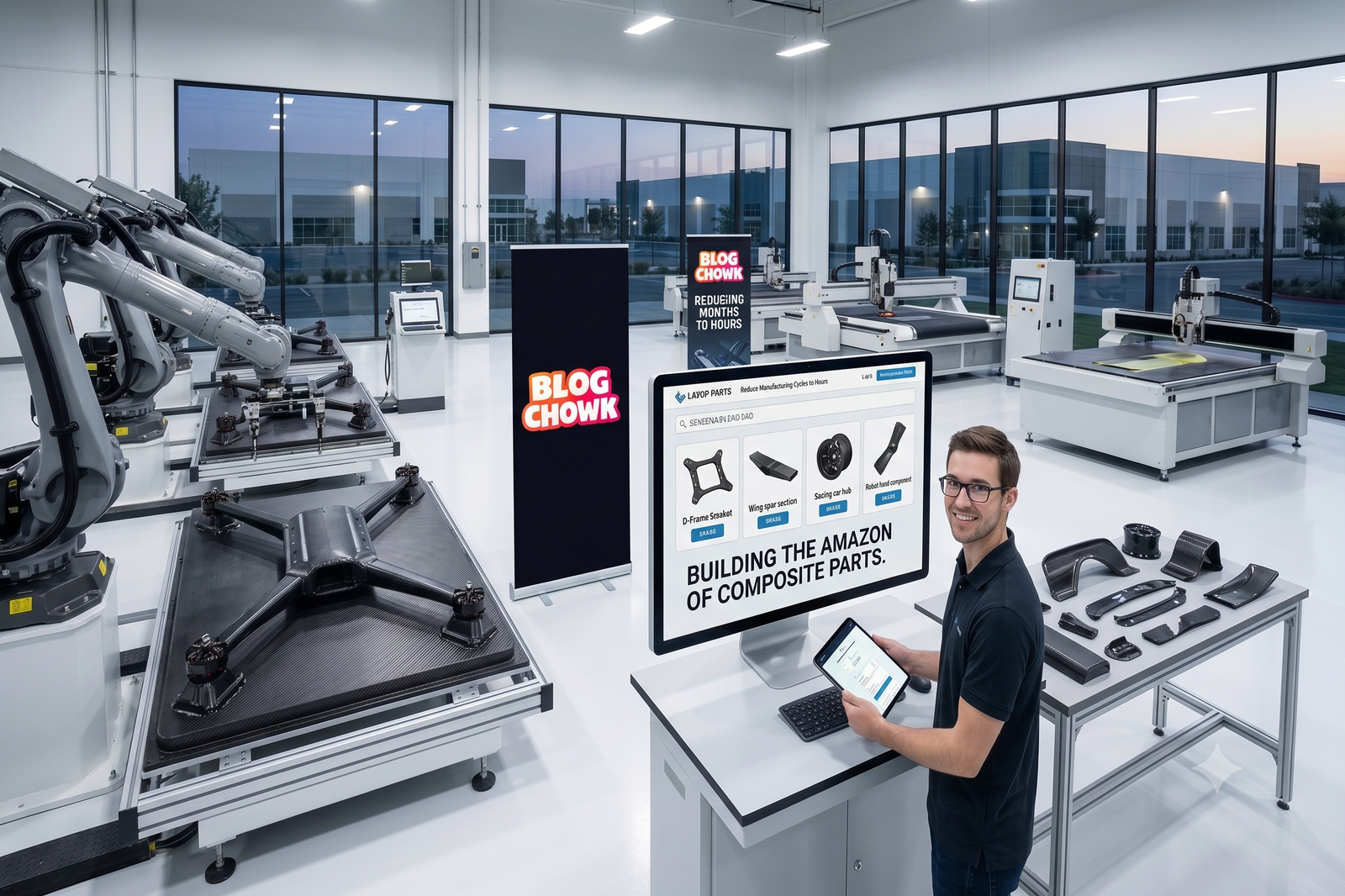
That massive headache is exactly what a California startup called Layup Parts wants to fix. Founded by Zack Eakin, a veteran hardware engineer, the company just locked in a massive $42 million Series A funding round to completely flip the script. Their goal is as bold as it gets: they are building the Amazon of composite parts. By pairing custom factory automation with a sleek digital storefront, they want to cut down legacy procurement times from agonizing months to just a few hours.
Here at Blogchowk, we monitor the deep tech and venture capital spaces closely. This massive funding round signals something big: investors are finally willing to pour serious capital back into heavy physical hardware, provided it is running on smart software.
The True Value of Composite Materials in Modern Tech
To understand why investors are throwing millions at this problem, you have to look at why composites dominate high-performance engineering. When you take carbon fiber or fiberglass and fuse it with a specific polymer resin matrix, you get a material that behaves like a superpower. It gives you an incredible strength-to-weight ratio that leaves heavy metals like steel and aluminum completely in the dust.
Because these parts are insanely light and durable, they have become the absolute lifeblood of several cutting-edge fields. Take aerospace and defense, for instance. Every single ounce saved on a military drone or commercial rocket directly translates to longer flight times and heavier payloads. The same logic applies to motorsports and automotive racing, where teams rely on carbon fiber chassis to shave fractions of a second off lap times while keeping a rigid safety cell around the driver. Even in advanced robotics, swapping out metal limbs for lightweight composite materials reduces inertia, allowing autonomous systems to move faster while consuming way less battery power.
From Defense Tech to an Automated Industrial Marketplace
The inspiration behind Layup Parts comes straight from its founder’s impressive career path. Zack Eakin spent roughly two decades working at the bleeding edge of hardware design. He built carbon fiber structures for IndyCar teams, and back in 2017, he became the very first engineer hired at Elon Musk’s tunneling venture, The Boring Company.
Eventually, Eakin joined Anduril Industries—the disruptive defense tech startup—to run their internal composite manufacturing efforts. That is where the reality of the supply chain bottleneck became unavoidable. He realized that while software had optimized almost every other part of the hardware stack, making carbon fiber brackets still relied on an archaic network of fragmented suppliers and manual hand-layering techniques.
When Eakin left to fix this issue, he brought a strict first-principles engineering approach with him. He even stress-tested his business model with Anduril’s own leadership team, getting strategic advice from co-founders like Palmer Luckey, Brian Schimpf, and Matt Grimm on how to pitch the venture capital world.
What a $42 Million Series A Tells Us About the Market
Pulling off a $42 million Series A for an asset-heavy hardware business is a massive statement. Led by Marlinspike—a venture firm deeply rooted in strategic defense and dual-use tech—the funding round also drew in major players like Cerberus Ventures, Pinegrove Venture Partners, Lux Capital, and Founders Fund.
This capital injection sends a clear message that hard tech is no longer playing second fiddle to software-as-a-service platforms. Investors are realizing that building physical things is highly lucrative if you use software to build a protective moat around your operations. On top of that, supply chain innovation has officially become a national security priority. With geopolitical tensions rising across the globe, relying on slow, opaque offshore suppliers for critical military and aerospace hardware is a massive vulnerability. Domestic manufacturing speed is now a strategic necessity.
Redefining Advanced Manufacturing and Tackling the Risks
The comparison to Amazon makes perfect sense when you look at the actual user experience. Layup Parts operates as a centralized industrial marketplace that strips away all the traditional friction. An engineer uploads a 3D CAD design, the platform immediately handles the quoting via software, and the backend digital pipeline translates those blueprints straight into automated workflows on the factory floor.
This model completely eliminates the legacy artisan trap, where human workers had to spend hours meticulously laying down carbon fabrics by hand into custom molds. By infusing advanced manufacturing tech into the mix, Layup Parts removes the need for slow design reviews, making high-grade materials accessible to both fast-moving startup teams and massive enterprise OEMs.
However, scaling a business like this is not without its hurdles. Unlike pure software companies, expanding physical production capacity requires immense capital expenditure for robotic machinery and large factory facilities. Managing cash burn will be crucial. Furthermore, meeting strict aerospace regulations means quality control must be flawless, since a single structural defect in a component could completely derail the company’s reputation.
Conclusion
The news that an ex-anduril engineer raises $42M to streamline this industry marks a massive turning point for modern manufacturing. Layup Parts is showing the sector that even the most stubborn, traditional industrial processes can be pulled into the digital age. For the entrepreneurs and tech enthusiasts keeping tabs on Blogchowk, this milestone serves as a loud reminder that the physical world is still incredibly ripe for bold tech disruption.