
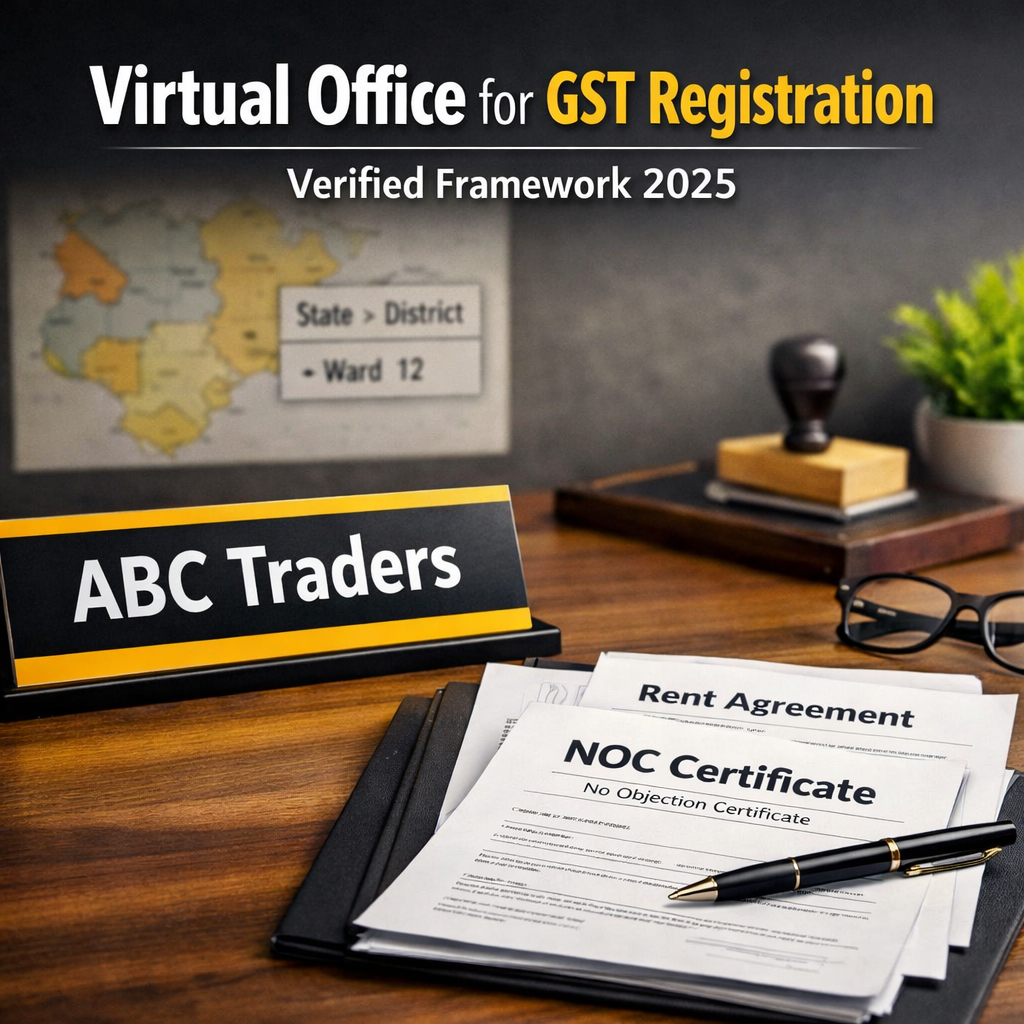
You can use a virtual office for gst registration in India as long as you have the right paperwork and a good business reason for doing so. This is a common method that businesses use to meet the address requirements set by the GST rules in each state and the Central Goods and Services Tax Act, 2017.
Getting to Know the Law
To pay GST, people don’t have to own commercial property. A registered person can call their rented or agreed-upon address their Principal Place of Business (PPOB) as long as they can prove they own it. The officer may ask for proof that you own the property during a physical inspection or an investigation under Sections 25, 27, or 28 of the CGST Act. When a service provider like TheGSTCo gives you an address, you need to show proof of that address, like a utility bill, a property tax receipt, or a city record. You also need a valid rent or sublease agreement and a No-Objection Certificate (NOC) from the person who owns or rents the property. If asked during verification, an affidavit saying you own something is not required but is a good idea.
It’s fine as long as the virtual office for GST registration shows real usage rights and not a fake claim.
The GSTCo’s Verified Address Framework for 2025
The GSTCo runs a system for checking addresses for GST registrations in several Indian states. It is for both sellers on the marketplace and people who offer services but don’t sell online. Their address system focuses on:
• Pre-verified business premises
• Standardized NOC formats that match GST officer standards
• Real-time compliance support
• A structured address hierarchy for jurisdiction accuracy
• Being ready for physical inspection by an officer
This makes sure that a virtual office for GST registration is not only legal on paper, but also can be checked out in person by officers.
Make sure you have the right jurisdiction and follow the PPOB. It is very important to tag jurisdictions correctly. According to GST verification rules, if the PPOB address is not in the declared officer’s area of responsibility, the application may be marked as a mismatch. The GSTCo architecture helps with this by giving out addresses that are connected to:
• Correct codes for states and districts
• Tags for the Ward/Circle area
• Geographic coordinates (not required, but helpful for verification)
• Proof based on landmarks to help field officers get around
If the jurisdiction data isn’t consistent or changes a lot during the verification window, a virtual office for GST registration is seen as high risk.
Things that will get you kicked out in 2025
If the following conditions are met, GST registrations may be put on hold:
• You don’t give your bank information within 30 days (compliance triggered by portal recommendation)
• Physical inspections can’t confirm evidence of address
• Officer verification makes a lot of quick adjustments
• The lease has ended or the landlord won’t renew it.
• An affidavit or NOC is needed but not given.
A virtual office for GST registration would be safe if these problems are fixed ahead of time.
People who sell things in the market have an edge
To sell on sites like Amazon, Flipkart, and Meesho, you need an active GSTIN so you can start selling and pay your taxes. The GSTCo adds value by combining address infrastructure with marketplace enablement services like:
• Cataloging Support
• GSTIN-based Marketplace Activation
• Amazon Account Management Services
• Papers that prove compliance when an account is turned off or on again • A dashboard that shows performance and tax compliance
Businesses that use a virtual office to sign up for GST might be able to get into the market faster because their paperwork is better organized and their addresses are more reliable.
Be ready for an officer to come by: a useful list
If an officer checks someone’s ID, the person applying should make sure that there is a name board or trade name sign at the business, a copy of the rent agreement and NOC on site, and an authorized representative there if the owner is not.
• An electricity bill or proof of the most recent utility bill on hand
• If asked, proof of latitude/longitude or a site photo affidavit is optional.
During these visits, a virtual office for GST registration must show that it has real ownership rights and a place of business.
8. Format for Address Display Board (Recommended for Compliance)
Display boards should be at least 2 feet by 4 feet in size, or bigger if they are easy to see from where they are.
• Font: Use professional-looking fonts like Inter that are easy to read and clean.
• Colors: Use the colors of your brand or colors that are easy to read.
• Must include: full address, trade name, and state
• Optional: GSTIN (once given) and a landmark reference
This isn’t against the law, but it will make police more likely to believe you and less likely to deny your application.
Affidavit Template for Address Possession (Only if Asked For) If the GST officer asks for an affidavit, it should include the following:
• A statement that you are the legal owner of the property
• The reason for the change in GST registration or core field
• A mention of the rental agreement, the electricity bill, and the papers that prove ownership As needed, sworn before a Judicial Magistrate or Notary Public
If you look closely, a virtual office for GST registration that is backed by a court affidavit is a better piece of evidence.
Keywords for SEO Article Placement
• GST registration for a virtual office
• activating a GSTIN for eCommerce
• following GST rules in more than one state in India
• managing an Amazon seller account in India
• the legal framework for the PPOB amendment
• the NOC standards for GST 2025
• the GST officer’s physical verification checklist
• the affordable business address GST India
• the accuracy of the virtual office jurisdiction Last Thoughts on GST
In 2025, it is still legal and safe to use a virtual office for GST registration as long as the address can be verified, the agreements are still in place, the owner gives clear permission, and the business intent is true. The GSTCo’s verified address architecture makes it easier to follow the rules, cuts down on complaints from GST inspectors, and speeds up the process of getting Indian digital commerce businesses to start selling on the marketplace.