
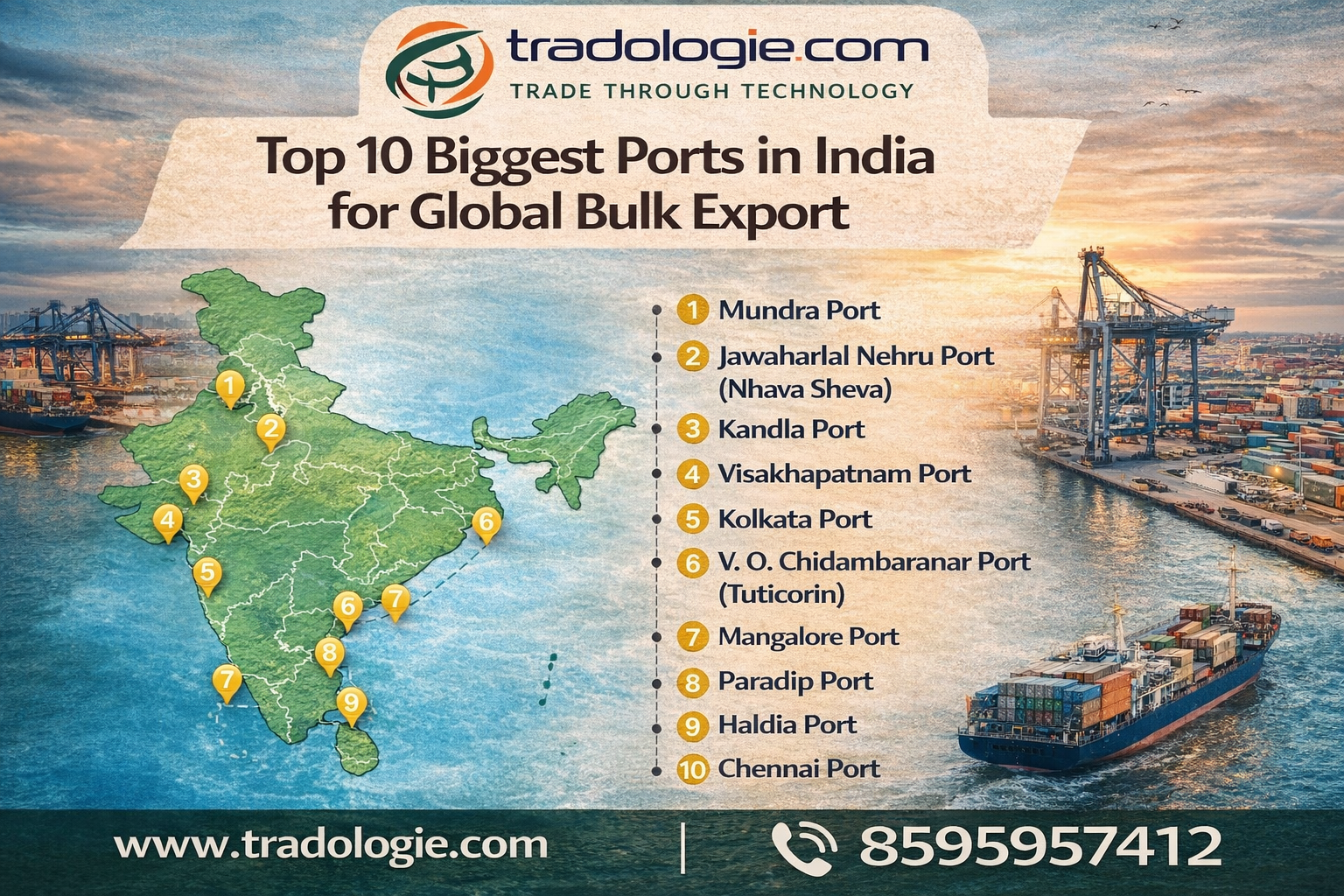
In export trade, volume is credibility. The sheer number of cargoes leaving the yard is everything. And that is the pretty evident reason that hierarchy among top Indian ports is less about perception and more about tonnage handled.
According to the Ministry of Ports, India’s major ports together handled roughly 819 million tonnes of cargo during 2023–24. That number alone tells you something — bulk trade in India is not a trickle. It’s industrial scale.
For exporters and importers planning bulk shipments — whether coal, iron ore, fertilizers, grains, or edible oils — port selection is a cost variable. Below is a grounded look at the top 10 biggest ports in India based strictly on cargo handled.
1. Deendayal Port (Kandla)
Cargo handled: ~132 million tonnes
If you scan the Indian port star list, Deendayal usually sits at the top. Petroleum, crude, fertilizers, food grains, coal — the mix is heavy and industrial.
For bulk exporters, this is one of the strongest top port sites in India simply because vessel movement here is constant.
Agro Commodities Exported:
- Food grains (Wheat, Rice)
- Castor seeds
- Guar gum
- Oilseeds
- Edible oils (bulk)
- Animal feed ingredients
2. Paradip Port – Odisha :Top 10 Biggest Port in India
Cargo handled: ~126 million tonnes
Paradip port is another one such significant port that deserves emphasis for bulk exporters among all Indian ports.
It stands as one of the most cargo-intensive dry bulk hubs in India and boldly handles around 126 million tonnes, largely coal and ore.
For mineral exporters, paradip port isn’t optional — it’s structural.
Agro Commodities Exported:
- Limited direct agri exports
- Some bulk food grains (occasionally)
- Fertilizer raw materials (import-export cycle)
3. Jawaharlal Nehru Port (JNPT)
Cargo handled: ~84 million tonnes
JNPT is container-heavy, but its volume still places it firmly among the top ports in India. For agri exporters — rice, spices, pulses — this Indian port often becomes the preferred exit point due to global liner connectivity.
Agro Commodities Exported:
- Basmati Rice
- Non-basmati rice
- Pulses
- Spices (cardamom, cumin, turmeric)
- Processed food products
- Oil meals
4. Visakhapatnam Port
Cargo handled: ~81 million tonnes
Eastern mineral exports lean heavily on Vizag. Iron ore, alumina, and thermal coal move steadily from here.
Among ports in India, this one has long been bulk-focused rather than container-centric.
Agro Commodities Exported:
- Rice (especially from Andhra region)
- Maize
- Oil meals
- Tobacco
5. Mumbai Port
Cargo handled: ~63 million tonnes
Mumbai Port may not dominate headlines. However, without a shred of doubt, it remains significant in the liquid bulk and petroleum products trade.
For certain exporters, this Indian port still offers established trade lanes and dependable berth systems.
Agro Commodities Exported:
- Edible oils (bulk liquid)
- Sugar
- Spices
- Processed agro products
6. Mundra Port
Cargo handled: ~150+ million tonnes (including private port operations)
Though privately operated, Mundra is consistently among the largest top port sites in India by throughput. Bulk coal, agri cargo, edible oils, and containerised exports pass through here on a massive scale.
For exporters, Mundra is often chosen for efficiency more than geography.
Agro Commodities Exported:
- Basmati Rice
- Non-basmati rice
- Wheat
- Maize
- Oil meals (Soybean meal, Rapeseed meal)
- Castor oil
- Edible oils
- Spices
7. Chennai Port
Cargo handled: ~51 million tonnes
7. Chennai Port
Cargo handled: ~51 million tonnes
Chennai isn’t the kind of port that shouts for attention, but anyone who exports out of South India knows how dependable it is. Roughly 51 million tonnes of cargo passed through its terminals last year — a mix of industrial consignments, agri shipments, and steady bulk movement that keeps trade flowing without drama.
For traders eyeing Southeast Asia, Chennai often feels practical rather than flashy. Sailing times are shorter, shipping lines are well accustomed to the route, and vessel schedules tend to move with less unpredictability than some of the more congested gateways.
Chennai remains important for southern exporters. Industrial goods, agri cargo, and bulk commodities continue to move through this Indian port, particularly toward Southeast Asia.
Agro Commodities Exported:
- Rice (South Indian varieties)
- Spices
- Tea
- Coffee
- Oil meals
8. Haldia Dock Complex
Cargo handled: ~45 million tonnes
Part of the Kolkata system, Haldia supports eastern bulk flows — especially petroleum, coal, and fertilizers.
For exporters in eastern India, this ranks among the practical top port sites in India due to inland access.
Agro Commodities Exported:
- Rice (Eastern India)
- Jute
- Tea
- Oilseed products
9. New Mangalore Port
Cargo handled: ~42 million tonnes
Iron ore pellets, petroleum products, fertilizers — New Mangalore may not be the largest, but within southern ports in India, it plays a steady bulk role.
Agro Commodities Exported:
- Coffee
- Cashew
- Spices
- Marine products
- Iron ore pellets (non-agri major)
10. Cochin Port
Cargo handled: ~34 million tonnes
Cochin handles petroleum products, fertilizers, spices, and marine exports. For southern exporters of agri commodities, it remains one of the quieter but reliable top ports in India.
Agro Commodities Exported:
- Spices (Pepper, Cardamom)
- Tea
- Coffee
- Coconut products
- Marine exports
Why Tonnage Matters in Bulk Export
In bulk trade, scale affects:
• Vessel availability
• Freight negotiation power
• Draft depth for larger carriers
• Congestion risk
• Turnaround time
When a port moves over 100 million tonnes annually, shipping lines prioritize it. That impacts exporters directly.
Spotlight on Paradip Port
Paradip Port deserves emphasis for bulk exporters among all Indian ports.
The port handles roughly 126 million tonnes of cargo in which a large amount is coal and ore, and it stands as one of the most cargo-intensive dry bulk hubs in India.
For exporters in mineral belts, paradeep sea port reduces inland haulage and aligns naturally with Capesize and Panamax vessel movements.
The Bigger Picture: India’s Bulk Strength
Collectively, major ports in India handled more than 800 million tonnes in FY 2023–24.
That is not incremental trade growth — that is industrial throughput.
The conversation around the top 10 biggest port in India isn’t about ranking for prestige. It’s about where volume flows predictably.
Because in bulk export, the port is not just an exit point.
It is a pricing variable.
Exporters who understand that usually negotiate better freight.
Importers who track it usually forecast better landed cost.
And in global trade, small advantages compound.