
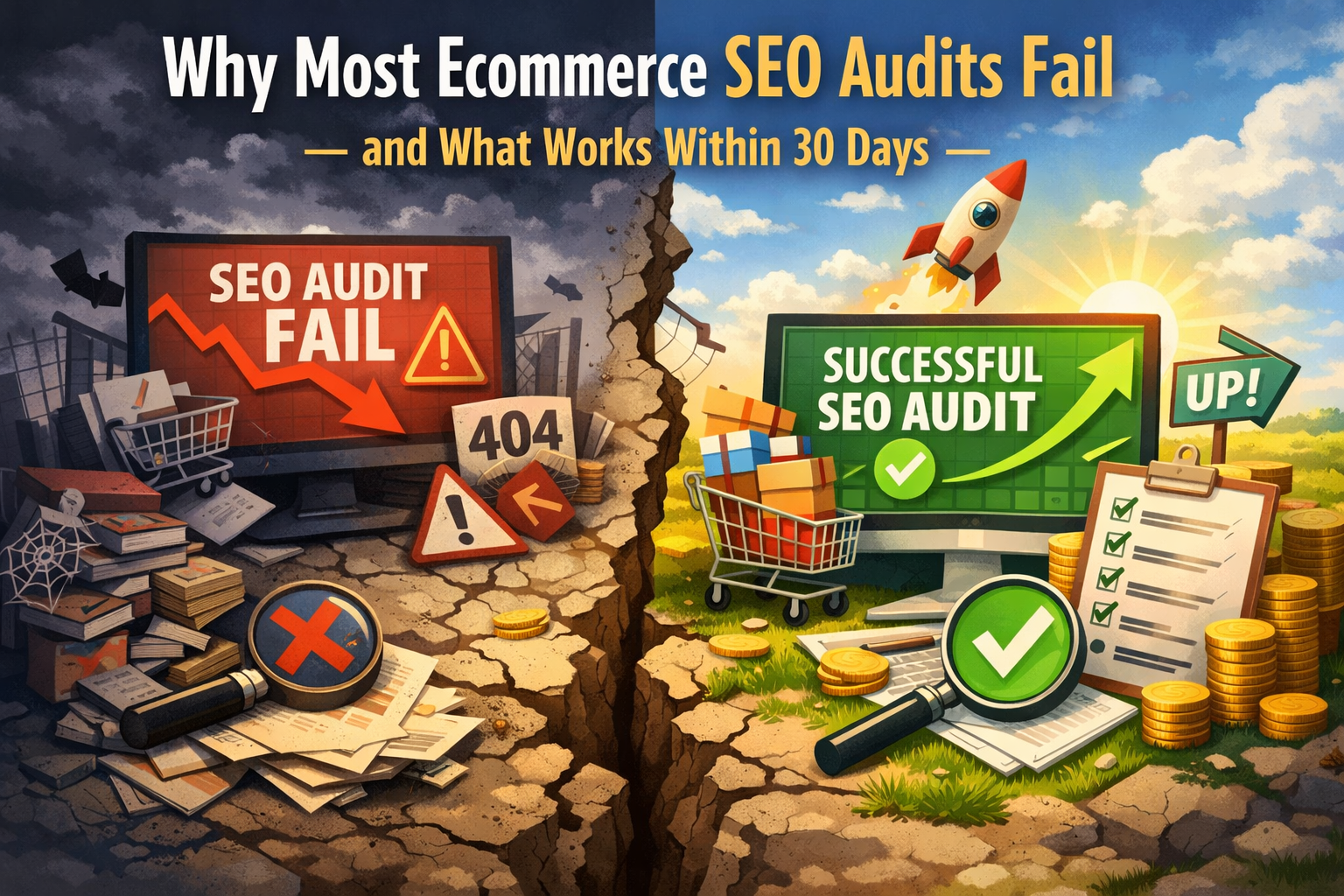
Ecommerce businesses invest heavily in SEO audits with the hope of improving rankings, traffic, and sales. Yet, many store owners feel disappointed weeks later when nothing changes. The truth is that most Ecommerce SEO audits fail not because SEO does not work, but because audits are often done incorrectly, too broadly, or without clear execution priorities. Understanding why these audits fail — and what actually delivers results within 30 days — can help ecommerce brands turn SEO into a measurable growth channel.
Understanding the Real Purpose of an Ecommerce SEO Audit
An ecommerce SEO audit is meant to identify technical issues, content gaps, and optimisation opportunities that directly impact visibility and conversions. However, many audits turn into long checklists that explain what is SEO in theory rather than addressing what truly matters for an ecommerce website.
A successful Ecommerce SEO audit should not be a textbook explanation. It should be a practical roadmap focused on fixing revenue-blocking issues first. When audits lose this focus, they fail to produce results.
Common Reasons Why Ecommerce SEO Audits Fail
They Focus Too Much on Tools, Not Strategy
Many SEO audits are generated using automated tools. While tools are useful, they often highlight hundreds of issues without context. Store owners receive reports filled with broken links, missing alt tags, and minor warnings that have little impact on performance.
Ecommerce SEO requires strategic prioritisation. Fixing a missing meta description on a low-traffic page will not move revenue. Audits fail when they do not align recommendations with business goals.
No Clear Understanding of What Is SEO for Ecommerce
A major reason audits fail is the lack of clarity around what is SEO in the ecommerce context. SEO for blogs and service websites differs significantly from ecommerce SEO. Product pages, category structures, internal linking, and crawl budgets play a much bigger role.
Audits that apply generic SEO rules without ecommerce-specific insights often miss critical issues such as poor category optimization, faceted navigation problems, or duplicate product content.
Too Many Recommendations, No Action Plan
Another common failure point is overwhelming the business with too many recommendations at once. A 70-page audit document may look impressive, but it often leads to inaction.
Effective Ecommerce SEO audits focus on what can realistically be implemented in the first 30 days. Without a clear execution plan, even accurate insights fail to deliver results.
Ignoring Search Intent and Buyer Behaviour
Many audits focus solely on technical metrics while ignoring how users search and buy products. Ranking for irrelevant keywords or informational terms that do not convert waste time and resources.
Understanding what SEO is also means understanding user intent. Ecommerce SEO audits fail when they do not align keyword strategies with transactional and commercial intent.
No Focus on Indexation and Crawl Budget
Large ecommerce websites often struggle with indexation issues. Thousands of URLs created through filters, sorting options, or session parameters can confuse search engines.
Audits fail when they do not prioritise crawl budget optimisation. Search engines wasting time crawling low-value pages means important product and category pages are ignored.
What Actually Works Within 30 Days
While SEO is a long-term strategy, certain Ecommerce SEO actions can show noticeable improvements within 30 days when executed correctly.
Fixing Critical Technical SEO Issues First
Instead of addressing every warning, successful audits focus on critical technical issues that block visibility. These include incorrect robots.txt rules, noindex tags on important pages, broken canonical tags, and major site speed problems.
Understanding what is SEO from a technical standpoint helps businesses realise that search engines must first be able to crawl and index pages properly before rankings improve.
Optimising Category Pages Over Product Pages
One of the biggest mistakes ecommerce audits make is prioritising product pages too early. Category pages usually drive more organic traffic and conversions.
Within 30 days, optimising category page titles, headings, content, and internal links can significantly improve Ecommerce SEO performance. These pages often rank faster because they target broader, high-intent keywords.
Improving Internal Linking Structure
Internal linking is a powerful yet overlooked aspect of ecommerce SEO. Many audits mention it but fail to provide clear guidance.
What works is creating logical internal links from high-authority pages such as top categories, blogs, or best-selling products to priority pages. This helps distribute link equity and improves crawl efficiency.
Understanding what is SEO includes recognising how internal links guide both users and search engines.
Cleaning Up Duplicate and Thin Content
Duplicate content is common in ecommerce websites due to similar product descriptions, variants, and filters. Thin content on category pages also limits ranking potential.
Within 30 days, rewriting key category descriptions and consolidating duplicate URLs can lead to better indexation and improved rankings. Ecommerce SEO thrives on unique, useful content that adds value beyond manufacturer descriptions.
Aligning Keywords With Commercial Intent
Keyword research is often done incorrectly during audits. Many focus on high-volume keywords without considering buyer intent.
What works is prioritising keywords that indicate readiness to purchase. Optimising pages for transactional queries improves conversion rates and makes SEO efforts measurable in revenue terms.
Knowing what SEO means, understanding that traffic alone does not equal success. Revenue-driven traffic does.
Improving Core Web Vitals and Page Speed
Site speed has a direct impact on user experience and rankings. Ecommerce sites with slow load times lose both traffic and sales.
Focusing on image optimisation, script minimisation, and server response times can produce noticeable improvements within 30 days. Strong Ecommerce SEO performance depends heavily on fast, stable pages.
Why Execution Matters More Than the Audit
An audit itself does not improve rankings. Execution does. Many businesses invest in audits but fail to allocate resources for implementation.
What separates successful ecommerce brands is their ability to act quickly on high-impact recommendations. Understanding what SEO is as an ongoing process, not a one-time report, is critical.
Measuring Success the Right Way
Another reason ecommerce SEO audits fail is unrealistic expectations. SEO success is often measured incorrectly.
Instead of focusing only on keyword rankings, businesses should track organic revenue, indexed pages, category-level traffic, and conversion rates. Within 30 days, improvements in crawlability, impressions, and engagement are realistic indicators of progress in Ecommerce SEO.
Building a Sustainable Ecommerce SEO Framework
Short-term wins are important, but long-term success comes from building a scalable SEO framework. This includes standardised product content guidelines, SEO-friendly site architecture, and ongoing keyword research.
Understanding what SEO is at this level helps ecommerce brands move beyond reactive fixes and into proactive growth.
Final Thoughts
Most ecommerce SEO audits fail because they are too generic, too technical, or too disconnected from business goals. They explain problems but do not prioritise solutions. Successful Ecommerce SEO audits focus on execution, intent, and impact.
When businesses understand what SEO is in the ecommerce context and take targeted action within the first 30 days, results follow. SEO is not about fixing everything at once. It is about fixing the right things first and building momentum over time.