
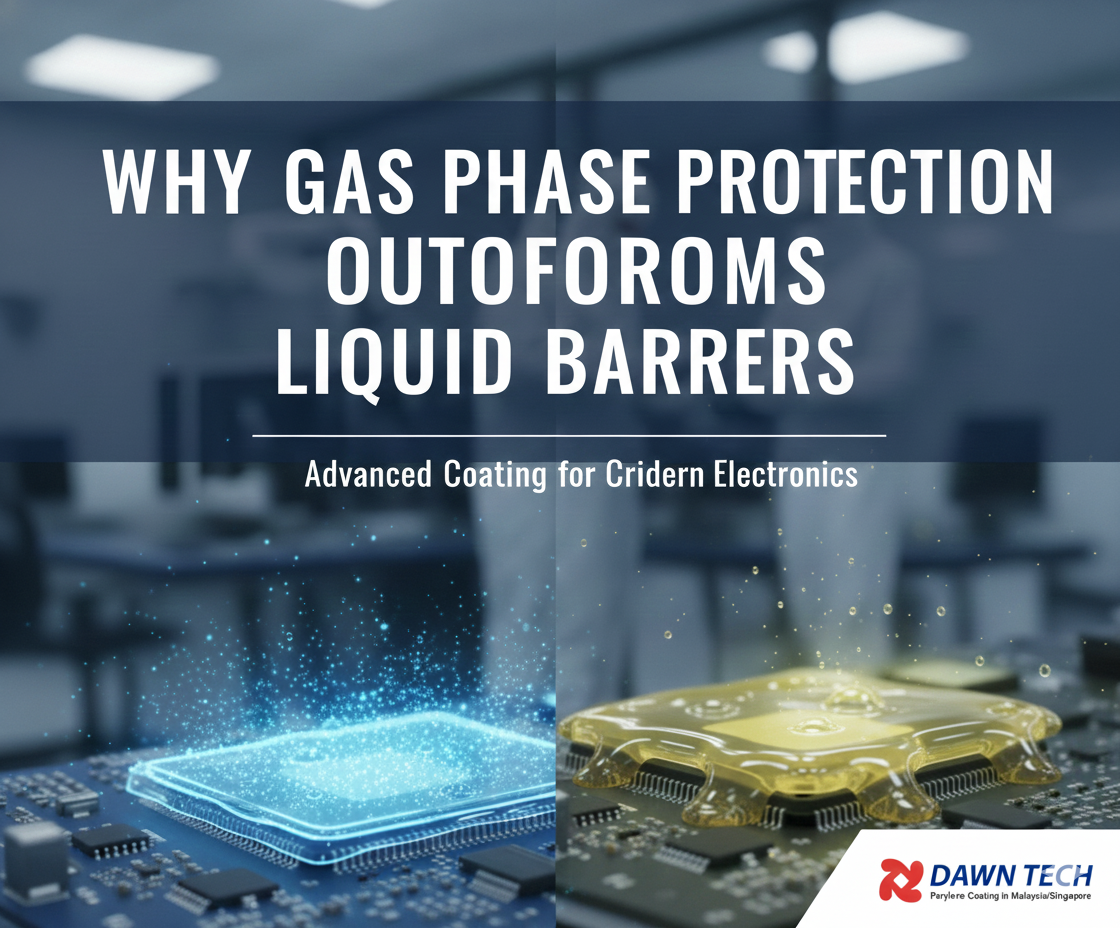
When you need to keep sensitive circuits safe from the weather, the choice usually comes down to two paths. Most people look for conventional coating suppliers first. These companies use liquids like acrylic or silicone resins. These materials are popular because they are cheap. They are also easy to apply with a spray gun or a dipping tank. But liquid resins have physical limits that can cause your parts to fail. I think it is risky to rely on liquids for hardware that must work in harsh spots.
The Failure of Liquid Flow
Liquid resins follow the laws of physics in ways that can hurt your design. When you spray a liquid onto a board, it flows. It is subject to surface tension. This means the liquid naturally pulls away from sharp corners and the edges of components. This is a physical reality that you cannot avoid with a spray. It leaves the most sensitive parts of your board with almost no protection. While the flat areas might have a thick film, the corners are often bare.
There is also the problem of evaporation. Most liquid resins use solvents to stay thin enough to spray. As the resin dries, those solvents turn into gas and leave the film. This process can create tiny holes. We call these pinholes. You might not see them, but moisture and salt will find them. Once water gets under the film, it starts to eat the copper traces. I have seen many boards fail in the field because of these microscopic gaps. It is a slow failure, but it is a common one.
How the Gas Process Works
Parylene Coating is a different approach. It is not a liquid. It is a gas. The process happens inside a stainless steel vacuum chamber. You start with a solid material called a dimer. You heat this dimer until it turns into a gas. Then, that gas moves through a furnace that breaks the molecules apart. Finally, the gas enters a room temperature chamber where your parts are sitting.
Because it is a gas, it does not care about gravity. It moves into every tiny gap on your board. It covers sharp corners and flat surfaces with the exact same thickness. It builds up one molecule at a time. This results in a solid barrier with no holes. You do not have to worry about the material pulling away from an edge or pooling in a corner. The thickness is perfectly even across the whole part.
Comparing Parylene to Nano Coating
You might also see Nano Coating in your search. These are often thin films made from fluoropolymers. They are popular because they are fast to apply. But there is a big difference between a simple Nano Coating and a gas barrier. Many nano films are hydrophobic. This means they repel water, like wax on a car. They are good for a light splash of rain.
Parylene is a true barrier. It does not just repel water; it blocks it completely. It is much denser than a typical Nano Coating. If your part needs to sit underwater or handle corrosive gases for years, the gas process is the better choice. I have noticed that people often try a cheaper nano film first. They usually switch to a gas barrier after their parts fail a salt fog test.
Why the Medical Industry Uses Gas
The medical industry relies on this material because it is inert. This means it does not react with the human body. If you have a sensor that goes inside a patient, it has to stay clean and safe. Body fluids are very salty and warm. They will destroy electronics fast. This gas barrier stays stable for years. It does not leak or break down. Surgeons use it for pacemakers, brain sensors, and even surgical tools. You can see the types of equipment used for this at Dawn Tech by visiting https://dawntechsb.com/.
The Difficulty of Masking
Masking is the most difficult part of the job. Since the gas goes everywhere, you have to cover up anything you do not want coated. This includes connectors, battery terminals, or buttons. Masking for a gas process is much harder than masking for a liquid spray. It requires a lot of manual labor and a steady hand.
Workers have to use tiny bits of tape or dots of special gel to seal the ports. If the masking is sloppy, the gas will get inside your connectors. Then your device will not plug in. I have seen projects delayed for weeks because someone had to spend a week scraping coating out of a USB port with a needle. You want a partner who is patient and pays attention to the small details.
Maintenance and Lab Safety
A vacuum process is only as good as the prep work. If a board has a fingerprint or a bit of oil on it, the coating will not stick. It might look fine at first, but it will eventually peel off. Good shops spend a lot of time on cleaning. Most quality providers use a plasma clean step. This uses ionized gas to scrub the board at a molecular level. It is a very deep clean.
If your supplier skips this, you are taking a risk with your hardware. You should also check the maintenance logs of the machines. A dirty vacuum chamber can lead to cloudy coating. I think it is vital to pick a partner who keeps a clean lab. You can find more about these quality steps at https://dawntechsb.com/.
Cost vs Reliability
A vacuum process costs more than a simple spray booth. You pay for the machine time, the electricity, and the specialized labor. But you should think about the total cost of your product. If you build ten thousand units and one hundred of them fail because of a leak, what does that cost you? You have to pay for shipping, repair labor, and new parts. You also lose the trust of your customers.
When you look at it that way, Parylene Coating is a solid investment. It is a way to make sure your parts are reliable. It is the best choice for electronics that simply cannot fail. Testing a few parts with a sample run is the best way to see the difference. Most good shops will coat a few samples for you so you can run your own tests.